Comparison
of Conventional Oxygen Concentrators
and Advanced Technology Fractionators
|
Zeolite
molecular sieves are used in conventional oxygen concentrators. These
units can produce a continuous stream of highly concentrated oxygen
(over 94%) using air as the feedstock. Air contains 21% oxygen, 78%
nitrogen and about 1% argon. A schematic diagram of a typical oxygen
concentrator is reproduced below.
|
|
Conventional
Two-Bed Oxygen Concentrator |
|
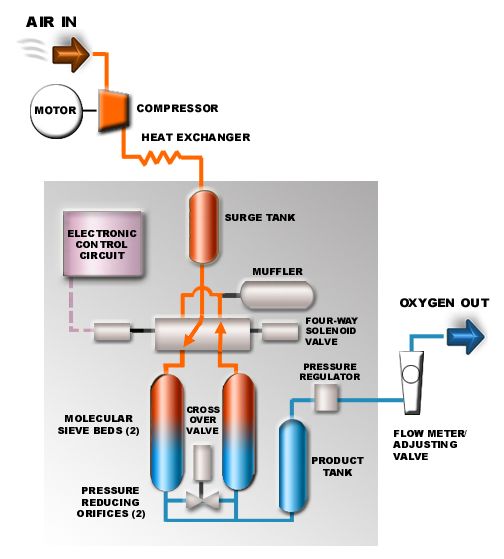
Air enters the system at the compressor intake. The compressor increases the air pressure to between two to three atmospheres. An air-to-air heat exchanger is used on some units to lower the temperature of the compressed air to enhance the adsorption process. The compressed air is then directed through one of the two molecular sieve beds. Here, the nitrogen in the air is adsorbed. The airflow is directed by a four-way solenoid valve, which is controlled by an electronic circuit. Concentrated oxygen flows out of the molecular sieve bed and through a pressure- reducing orifice into a product tank. This flow of oxygen is split into two streams. The smaller stream is routed to the point of use by way of a pressure-reducing regulator and an adjustable flow control valve. The larger stream of concentrated oxygen is diverted through another pressure- reducing orifice and flows through the molecular sieve bed being purged. This purging bed is connected by the four-way valve to atmosphere to allow venting of the desorbed gases. The cycle described above is reversed every five to ten seconds, so each molecular sieve bed is alternately adsorbing and purging. When the cycle is reversed, the four-way valve shuts off all flow into the beds momentarily while the crossover valve opens to equalize the pressure between the two beds. Note
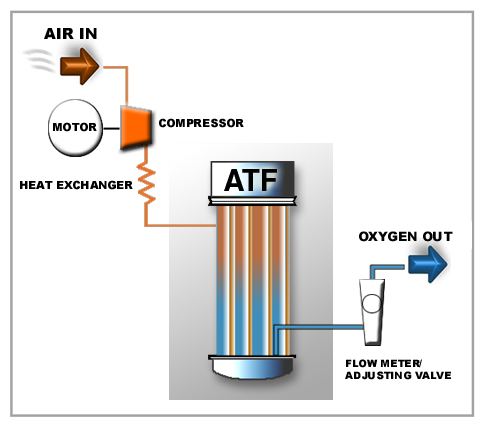
the boxed portion of the schematic diagram of an ATF- based oxygen
concentrator (depicted below) serves the same functions as all of
the components in the boxed portion of the diagram of a conventional
concentrator pictured above. ATF-Based
Concentrator |
|
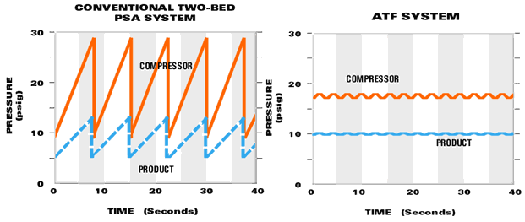
The two graphs shown below depict the operating pressures versus time for both conventional and ATF-based oxygen concentrators. The variation in compressor pressure (solid line) with the ATF is far less than that exhibited by the conventional concentrator. The oxygen product pressure (dotted line) is essentially constant in the ATF system.
|